
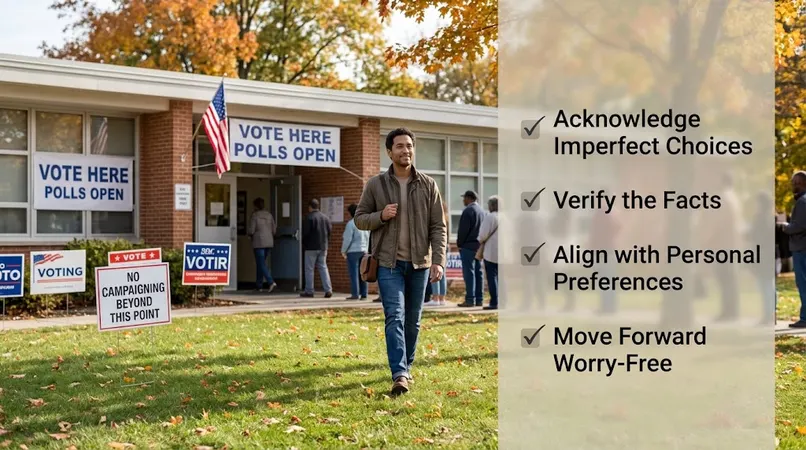
Few decisions carry as much weight, and induce as much stress, as choosing among imperfect options. In modern elections, voters routinely encounter ballots where every candidate or initiative feels flawed, messaging is intentionally obscure, and public discourse is flooded with scare tactics and conflicting claims.
When every path seems compromised, the natural human reaction is either analysis paralysis—freezing up in hopes that more information will resolve the dilemma—or rash surrender, picking impulsively just to escape cognitive discomfort. However, behavioral psychology and strategic decision frameworks offer clear, repeatable techniques to cut through manufactured noise, verify ground truth, and align difficult choices with your core values.
1. The Psychology of the "Imperfect Choice" Trap
When facing a choice between options that all carry notable drawbacks, our brains run into predictable cognitive traps:
-
The Information Overdose Trap: Research from decision analytics highlights our tendency to delay decisions, believing that "just a bit more data" will reveal an obvious answer. In hyper-polarized environments, more data often means more partisan spin, worsening cognitive fatigue without increasing clarity.
-
Maximizing vs. Satisficing: As behavioral economists note, "maximizers" strive for the absolute optimal outcome and suffer distress when no candidate or option is flawless. "Satisficers," by contrast, evaluate choices against clear, non-negotiable minimum criteria. When choices are imperfect, satisficing protects against paralysis.
-
Manufactured Anxiety and Scare Tactics: Fear-based messaging triggers System 1 thinking—fast, emotional, survival-oriented reflexes—bypassing the slow, deliberate analytical reasoning (System 2) needed to weigh policy trade-offs.
-
Ignoring the Emotional Dimension: As organizational strategists at McKinsey observe, failing to acknowledge personal emotional stakes leads to blind spots. When anxiety, tribal loyalty, or cynicism dictate your posture, objective evaluation collapses.
2. A Concrete Protocol for Verifying Facts in the Noise
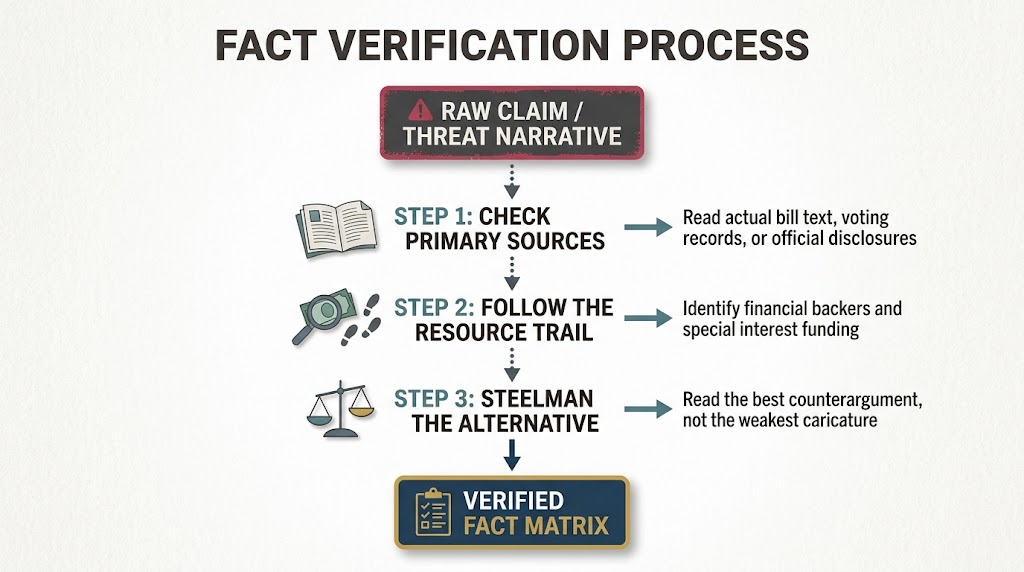
To counter intentional obscurity, you must replace passive content consumption with an active verification process:
-
Go Upstream to Primary Records: Skip news commentary, attack ads, and social media clips. If a candidate claims their opponent voted to defund a critical program, check the legislative record, roll-call votes, or formal bill summaries. If a ballot measure claims to "protect rights," read the exact statutory language.
-
Follow the Money and Endorsements: Official campaign finance databases and public disclosure filings reveal who wrote, backed, and financed an initiative or campaign. Knowing who benefits financially often clarifies intent faster than public relations statements.
-
Use the "Steelman" Technique: Actively seek out the strongest, most coherent argument from the opposing viewpoint rather than its caricatured version. If an opponent's critique makes sense when framed by their own advocates, you have identified a genuine trade-off rather than an attack line.
-
Apply the 37% Research Rule: Borrowed from optimal stopping algorithms in decision science, allocate roughly a third of your available research window to gathering raw information and validating claims. Once that window closes, stop searching for new input and focus exclusively on evaluating what you have found.
3. Aligning Decisions with Your General Preferences
When no candidate or ballot measure matches your platform, how do you map ambiguous choices to your real values?
| Framework | Core Question | How to Apply to Voting & Tough Choices |
| "What’s Not Going to Change?" | What core fundamentals will remain true 5 to 10 years from now? | Look past immediate campaign promises and identify structural impacts: fiscal solvency, institutional norms, civil liberties, or basic governance capacity. |
| Regret Minimization (10-10-10) | How will I feel about this choice in 10 minutes, 10 months, and 10 years? | Removes short-term emotional spikes (fear, disgust, peer pressure) and centers the long-term, durable consequences of the decision. |
| Scenario Planning & Robustness | Which alternative performs acceptably across multiple plausible futures? | Instead of banking on a candidate fulfilling an idealized agenda, assess which candidate creates the lowest downside risk in worst-case scenarios. |
| Conscience vs. Self-Interest | Which choice am I actively trying to avoid making, and why? | Clarifies whether your hesitance comes from uncomfortable ethical duties or simple social discomfort and tribal pressure. |
4. Building Your Personal Decision Matrix
To remove emotional distortion, transfer the choice from your head onto paper using a weighted criteria matrix:
-
Identify Your Top 3–4 Non-Negotiable Values: These might include fiscal discipline, public education funding, judicial integrity, or climate resiliency. Rank them by priority.
-
Score Options on Demonstrated Behavior, Not Rhetoric: Grade candidates based on their track records, committee actions, and consistent positions over time rather than stump speeches.
-
Separate "Flaws" into Two Categories:
-
Style/Rhetorical Flaws: Unpleasant demeanor, partisan rhetoric, media gaffes.
-
Structural/Consequential Flaws: Policy trajectories that directly undermine your core priorities or run counter to verified reality.
-
-
Accept the Trade-Off: Recognize that selecting the least objectionable option is an active strategic choice, not an endorsement of perfection. In complex governance systems, minimizing systemic damage or protecting baseline stability is often the most consequential contribution a decision-maker can make.
5. De-Stressing the Final Choice
-
Implement a 24-Hour Cooling Period: After completing your factual verification and matrix, step away from political media for a full day. Walking, resting, and disconnecting clears adrenaline and cortisol, enabling your brain to synthesize findings calmly.
-
Own the Choice and Move Forward: Effective decision-makers recognize that no choice made under high uncertainty comes with a guaranteed outcome. By decoupling the quality of your decision process from unforeseen external events, you can cast your vote with confidence, knowing it was grounded in verified facts, disciplined judgment, and personal conviction.
Reader Comments (0)
Want to leave a comment? Sign in with your account to participate.
Sign In to CommentNo comments yet. Be the first to join the conversation!