
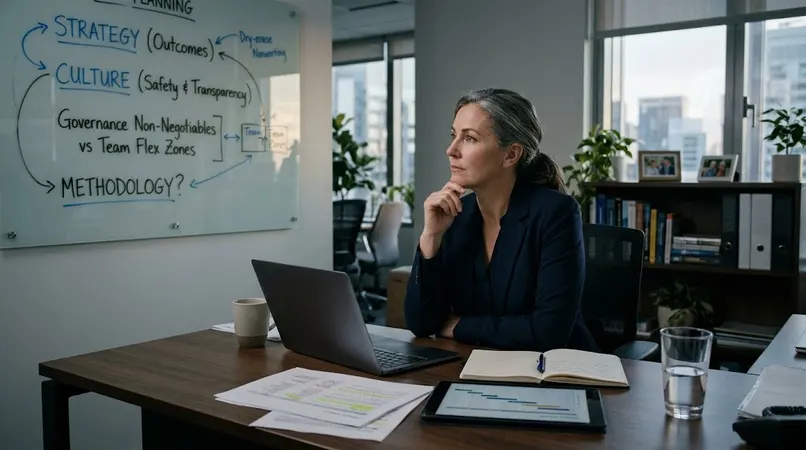
Deciding an organization will "run Agile," "implement SAFe," or "spin up Kanban boards" is one of the most common—and expensive—missteps leadership can make. When organizations adopt a delivery methodology by decree, they fall victim to framework cargo cults: mimicking the ceremonies, terminology, and artifacts of modern delivery without building the cultural soil, tooling ecosystem, or talent capabilities necessary to sustain them.
Frameworks like Scrum, Kanban, Extreme Programming, and SAFe are not strategies. They are tactical delivery engines. Selecting a framework before defining the business problem is akin to buying a racing transmission for a vehicle without checking whether the engine, fuel, or chassis can handle the torque.
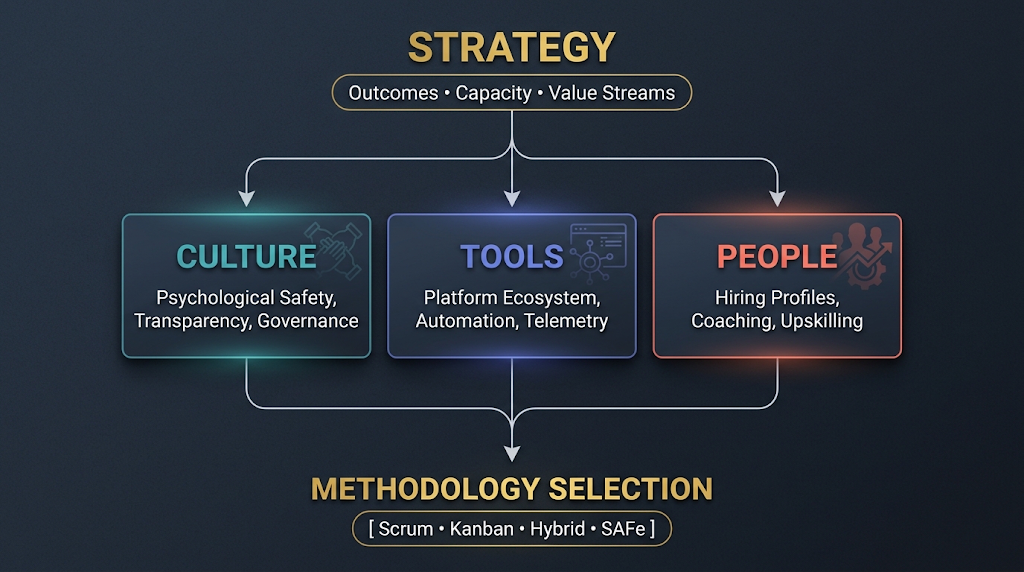
True project management maturity begins with a strategic charter that aligns organizational readiness, toolchain architecture, and talent acquisition into a unified operating model.
The Framework Trap: Methodology Without Culture
Many enterprise initiatives stumble not because their chosen framework is defective, but because the methodology runs headlong into organizational friction.
1. Cultural Friction: "Checking the Soil"
Project management principles are deeply ideological. They demand transparency, accountability, visible risk management, and the willingness to say "no" to unprioritized work.
In organizations that thrive on informal influence, backchannel priorities, or "hero culture" (rewarding firefighters while ignoring fire prevention), formal project governance is frequently attacked as red tape. As delivery consultant Tim Rogers observes, introducing rigid governance into an unprepared environment is like planting seeds without checking the soil: well-trained project leaders end up managing dysfunction instead of delivering value.
2. The Tooling Disconnect: Shelfware and Shadow Trackers
When leadership mandates a tool (Jira, Monday.com, Asana, Azure DevOps) to enforce methodology, teams treat the software as an administrative tax. Without a clear governance model—defining single intake channels, standard definitions of "done," and workflow guardrails—the tool becomes shelfware. Users quickly revert to shadow spreadsheets and backchannel chats, turning dashboards into vanity metrics rather than sources of truth.
3. Misaligned Talent Acquisition
Hiring strategies driven by buzzwords rather than operating reality create churn. An organization operating in a heavy regulatory landscape with waterfall dependencies will exhaust an Agile coach hired to run lightweight experiments. Conversely, hiring traditional command-and-control project managers into an evolving product-led team breeds resentment.
Strategic Decision-Making: The Architectural Inquiry
When establishing or restructuring a project management discipline, leaders must work through a structured sequence of architectural questions before signing software contracts or scheduling certification bootcamps.
Step 1: Organizational Readiness & Culture Assessment
What is our true capacity for transparency and accountability?
-
Evaluate Cultural Archetypes: Using diagnostic frameworks such as Cameron & Quinn’s Competing Values Framework or Kerzner’s Project Management Maturity Model (PMMM), evaluate whether the culture skews toward hierarchy, adhocracy, market competition, or clan-based consensus.
-
Examine Sponsorship Reality: Are executives willing to sponsor prioritized trade-offs in writing, or do they expect teams to absorb unlimited scope changes off the books?
-
Identify Governance Traps: Is documentation treated as a tool for cross-functional alignment, or as bureaucratic self-defense against blame?
Step 2: Value Delivery & Workflow Definition
What shape does our work actually take, and where does value leak?
-
Value Stream Mapping: Trace how an idea moves from strategic intent to customer value. Are teams managing high-uncertainty product discovery, or repetitive, compliance-driven operational throughput?
-
Methodology Matching: Match the delivery model to work characteristics rather than executive trends. High-uncertainty iterative software suits Scrum; continuous service delivery or maintenance aligns with Kanban; cross-team hardware-software interdependencies may require structured hybrid governance.
-
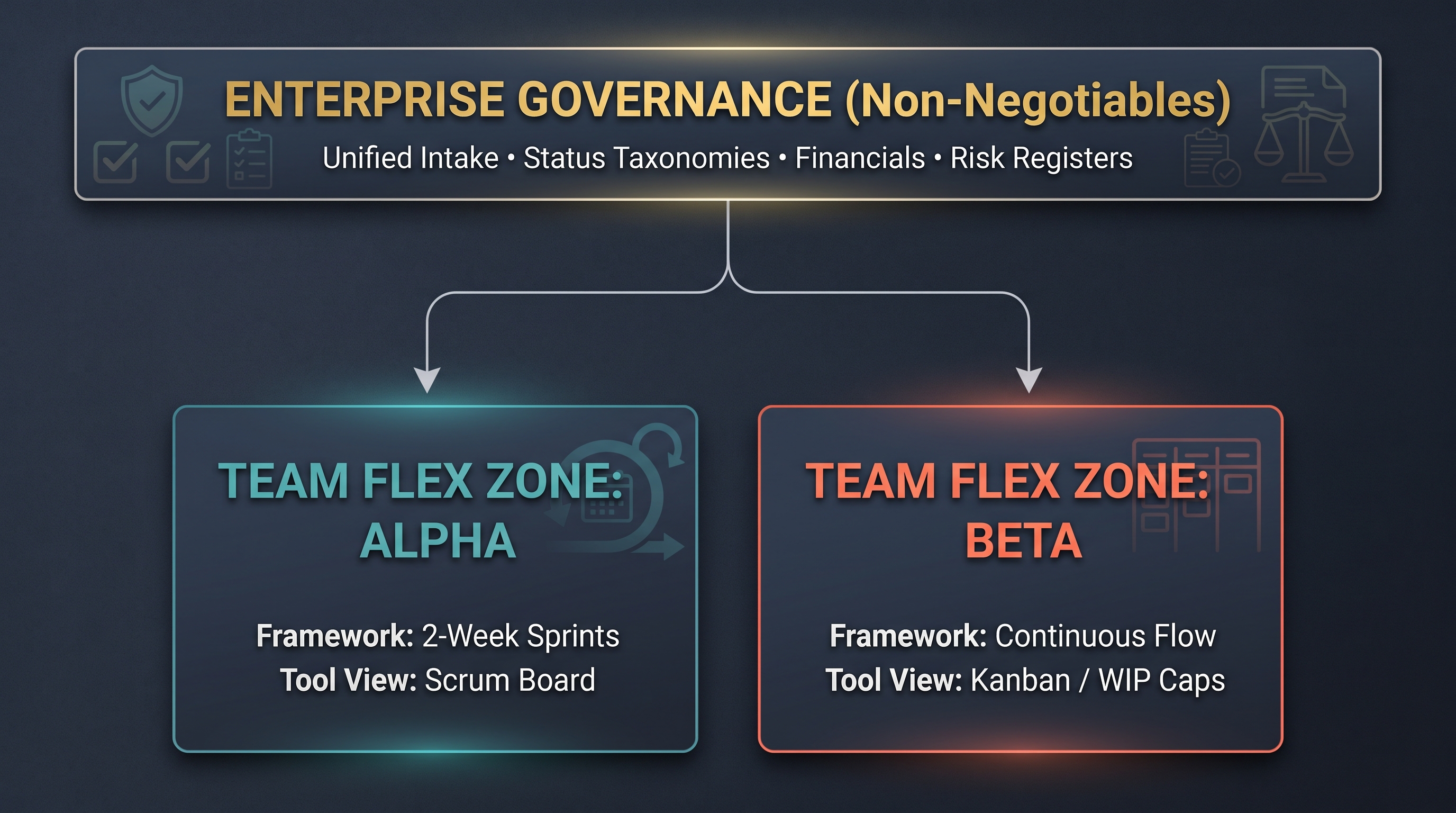
Define Non-Negotiables vs. Flex Zones: Establish enterprise baselines (intake standards, risk scoring, status definitions) while allowing individual teams autonomy over daily task management.
Step 3: Toolchain Architecture & Automation Design
How will our tool ecosystem eliminate friction rather than generate overhead?
-
Workflow Standardization Before Tool Deployment: Never automate broken, ambiguous processes. Document the intake, triage, and handoff stages manually before configuring complex automated platforms.
-
Friction Reduction via Automation: Deploy automation to handle handoffs, update parent-child hierarchies, and sync cross-tool notifications. If tracking progress requires more than a few clicks per week from contributors, adoption will stall.
-
AI Readiness & Telemetry: In modern delivery environments, predictive analytics, auto-scheduling, and generative status reporting require clean, structured data. Plan data hygiene early so AI capabilities can forecast delivery bottlenecks and optimize resource capacity effectively.
Step 4: Talent Strategy & Role Evolution
What capabilities must we recruit, train, and reward to sustain this discipline?
-
Calibrate Role Expectations: Determine whether the organization needs technical delivery leads, servant-leader Scrum Masters, strategic Program Directors, or product-oriented Delivery Managers.
-
Shift Performance Incentives: Stop incentivizing individual heroics and emergency late-night fixes. Align compensation, promotions, and recognition with system predictability, cycle time reductions, and transparent risk escalation.
-
Upskill for Modern Delivery Realities: Invest in training that balances hard governance and systems thinking with soft skills—stakeholder negotiation, conflict resolution, and data fluency.
Step 5: Phased Rollout & Iterative Governance
How do we prove value before demanding enterprise-wide compliance?
-
Execute Pilot Incubators: Choose a single cross-functional value stream as a testbed. Refine the toolchain integrations, team cadences, and reporting metrics in microcosm.
-
Build Continuous Feedback Loops: Treat the operating model itself as an evolving product. Establish an enablement group or PMO working group that regularly audits process friction and adjusts governance rules based on operational data.
Delivery Frameworks Compared: Cultural and Strategic Fit
Selecting a framework requires evaluating organizational realities, operational pacing, and tolerance for ambiguity:
| Framework | Core Operating Mechanism | Cultural Pre-Requisites | Ideal Work Type | Pitfalls of Misalignment |
| Kanban | Continuous flow, visual work items, strict work-in-progress (WIP) limits | High discipline, focus on throughput, tolerance for variable release dates | Operations, support, continuous infrastructure maintenance | Becomes an unmanaged to-do list without enforced WIP limits |
| Scrum | Timeboxed iterations (sprints), cross-functional teams, backlog grooming | Team autonomy, high psychological safety, daily cross-functional trust | Product discovery, novel software applications, iterative product builds | Degrades into mini-waterfall cycles with sprint-end crunching |
| SAFe | Synchronized cadence (PI Planning), layered portfolio governance | High tolerance for enterprise hierarchy, multi-tier program coordination | Large-scale multi-team initiatives with complex cross-dependencies | Stifles local agility under heavy administrative layers |
| Hybrid (Stage-Gate + Agile) | Milestone-driven phase gates paired with iterative execution loops | Balanced risk appetite, comfort with dual-track reporting styles | Regulated environments, physical hardware + software builds | Teams spend more time bridging reporting mismatches than delivering |
Building a Resilient Delivery Engine
Project management principles fail when treated as plug-and-play procedures. An organization cannot buy delivery predictability through software licenses, nor can it achieve agility simply by renaming team members "Scrum Masters."
Predictable value delivery requires a balanced operating foundation:
-
Strategic Intent: Clear corporate priorities that inform which projects receive resources and which are paused.
-
Cultural Readiness: A collaborative environment that treats transparency as alignment rather than vulnerability.
-
Frictionless Tooling: Platforms and automated workflows configured to reduce administrative overhead and surface real-time telemetry.
-
Targeted Talent: People who understand how to apply systems thinking to complex, changing business environments.
By addressing culture, tools, and talent systematically, organizations move beyond superficial framework adoptions to build a resilient, scalable project management capability.
Reader Comments (0)
Want to leave a comment? Sign in with your account to participate.
Sign In to CommentNo comments yet. Be the first to join the conversation!