

The Next Lever: Why Superintelligence Must Elevate, Not Replace, the Human Condition
Throughout history, human progress has never been defined by the tools we invent, but by what those tools enable us to become. From the first controlled spark of fire to the harnessing of electricity, the purification of municipal water, and the turning of the wheel, technological breakthroughs have routinely upended the physical and intellectual landscape.
Whenever a foundational technology arrives, a familiar apprehension surfaces: Will this make humanity obsolete?
Today, as artificial intelligence advances toward superintelligent capabilities, that question has returned with renewed urgency. Yet viewing advanced AI as an eventual replacement for humanity misunderstands both the nature of computation and the essence of the human spirit. Superintelligence is not a substitute for the human soul, human conscience, or human agency; it is an extraordinary leap in computational technology. Like the wheel, the lever, and the power grid before it, its true purpose is to lessen unnecessary toil, expand human potential, and elevate our shared condition.
The Cost of Resistance: From the Wheel to the Algorithm
When the wheel and the lever were first conceived, they did not eliminate the need for human builders, farmers, or explorers—they eliminated the crushing physical limitations that held them back. The laborer who stubbornly refused the wheel continued dragging heavy loads across rough terrain on his back. He worked significantly harder, produced far less, and was ultimately outpaced and replaced—not by the wheel itself, but by the person who embraced the wheel.

Every civilization-defining tool carries this imperative:
-
The Wheel and Lever: Multiplied muscle power, transforming manual labor into organized architecture and global trade.
-
Clean Water and Sanitation: Freed entire societies from waterborne plagues, lifting average life expectancies and unlocking vast reservoirs of human talent.
-
Electricity: Abolished the limits imposed by daylight and steam engines, powering everything from modern medicine to instant global communication.
Artificial intelligence represents the computational equivalent of these mechanical revolutions. Those who dismiss or refuse to learn the tool will find themselves working harder for diminished returns, struggling against friction that their peers have learned to eliminate. Yet just as a crane cannot decide what cathedral to build, advanced computation cannot decide what is worthy, noble, or good.
Understanding the Machine: Intelligence Without Consciousness
To use advanced AI effectively, we must discard Hollywood tropes of conscious machines. Empirical science continues to reveal a fundamental distinction between functional computation and the human mind.
A landmark October 2026 study from Ludwig Maximilian University of Munich (LMU), published in Cognition, demonstrated that people intuitively recognize this divide. Even when an AI system behaves and responds in a manner indistinguishable from a human, individuals draw a firm line between behavioral responsiveness and genuine consciousness. The researchers discovered that people rated even the most responsive AI as categorically less conscious than the least responsive human. While an algorithm can process data and demonstrate external "awareness" of surroundings, it possesses no subjective experience, empathy, or inner mental life. We anthropomorphize software because our language lacks terms for non-biological intelligence, but high-speed pattern recognition is not sentience.
Furthermore, computational systems lack the grounded cognitive resilience of biological minds. Research published in PNAS Nexus (June 2026) evaluated leading large language models using the classic Stroop task—a standard psychological test measuring executive control, concentration, and the ability to suppress automatic impulses. While advanced models handled brief tasks adeptly, their accuracy collapsed dramatically as sequences grew longer and distractions mounted, plunging from over 90% accuracy down to near-total failure. Unlike human brains, which possess executive control to maintain goal-directed focus against conflicting stimuli, AI models remain bound to statistical probability distributions.
Superintelligence, in this light, is not an emerging autonomous species; it is an immense, specialized cognitive engine that requires human direction, discernment, and oversight.
The Moral Compass: A Tool for Human Flourishing
Because AI is an instrument rather than an entity, the moral burden rests entirely on human shoulders. This principle was articulated by Elder Gerrit W. Gong at the 2026 G20 Interfaith Forum in Salt Lake City:
“AI will not fulfill its full potential until we make it as morally good as we make it powerful. And we will not fulfill our responsibility until we understand that we—and not any technology—must shape our best future.”
Addressing global civic and religious leaders, Elder Gong underscored that technological power must be anchored in enduring ethical principles, human dignity, and what initiatives like the Consortium for Evaluating Faith and Ethics in AI (CEFE-AI) term human flourishing. When used with purpose, advanced computation can expand human capacity to cure disease, distribute aid, solve environmental challenges, and lift underserved communities.
Yet preserving human flourishing requires understanding where the tool’s utility ends and human sacredness begins. In his discourse on AI and human relationships, Elder Gong cautioned against using software as a proxy for real connection:
-
Logistics vs. Life: AI can draft correspondence, organize schedules, analyze massive datasets, and handle operational logistics. It cannot, however, provide authentic empathy, friendship, or pastoral care.
-
Information vs. Truth: As Elder Gong noted, "Artificial intelligence can answer questions, but it cannot answer prayers. It can organize information, but it cannot offer revelation, covenant connection or divine truth."
-
Growth Through Effort: Speaking at BYU Education Week, Elder Gong warned against using AI as a shortcut to bypass the deliberate struggle that builds human character, intellect, and spiritual maturity. If a student relies on AI to do their thinking, or if a speaker outsources their personal reflection, the capacity for genuine growth atrophies.
Technology should deepen, not diminish, our relationship with ourselves, one another, and our broader moral responsibilities. We are not mere data points in an unfeeling algorithm; we are moral agents endowed with purpose.
Learning to Drive the Future
We need not fear artificial superintelligence, nor should we worship it as a panacea for the human condition.
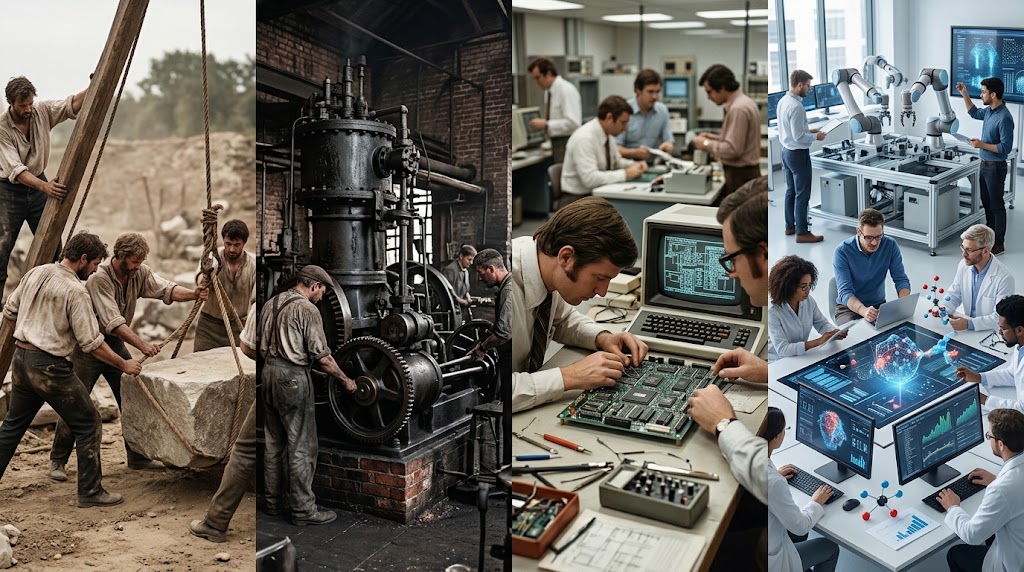
The path forward mirrors the lessons of every preceding technological epoch:
-
Master the Tool: Learn to harness advanced computing to solve complex problems, automate repetitive labor, and amplify research, just as earlier generations mastered the lever, the engine, and the computer chip.
-
Preserve Human Primacy: Keep human judgment, empathy, ethical accountability, and personal connection firmly in the driver’s seat.
-
Refuse False Substitutes: Recognize that software can process language, but it cannot cultivate wisdom; it can simulate conversation, but it cannot replace community.
The individual who refused the wheel was not preserved by their reluctance—they were merely exhausted by it. By contrast, those who picked up the wheel built roads, connected distant communities, and freed their energies to explore new frontiers. Superintelligence offers us the exact same crossroads: an opportunity to set down the heavy burdens of routine computation and lift our sights toward a more enlightened, compassionate, and capable human future.
Reader Comments (0)
Want to leave a comment? Sign in with your account to participate.
Sign In to CommentNo comments yet. Be the first to join the conversation!